Industry News
Mini Vertical Lift: Where It Pays and the Two Platform Types
A mini vertical lift solves the last two metres of an installation job: 220 kg, 4.9 m, and two platform types — flat for air-conditioning units, U-shaped for pipes and roller shutters.
The problem is not the weight. It is the last two metres.
Installation jobs rarely fail because nobody can pick the object up. They fail at the point where the object has to stop being carried and start being fixed.
That point is usually two to four metres off the ground, and it is where a ladder runs out of hands. A ladder gives you one hand for the load and one for balance. Fixing anything — bolting a bracket, seating a unit on its feet, clamping a pipe — takes both hands and a moment of stillness.
This article is about the specific class of equipment that closes that gap: the mini vertical lift, a portable electric material lift that raises a load to a working height and holds it there while a person works on it. It is not a crane and not a scaffold. It is the tool for the last two metres.
Three jobs where the last two metres decide the schedule
Outdoor air-conditioning units
A split-system condenser sits on wall brackets, a roof stand or a concrete plinth, typically between 2.5 and 4 metres up. The unit is boxy, awkward to grip and heavy enough that one person cannot safely hand it up a ladder. The installation sequence is the hard part: lift clear of the bracket, align four feet onto four bolts, hold position, and tighten. Three of those four steps need both hands.
Two installers on two ladders can do it, slowly, with the unit balanced between them and nothing holding it if either hand slips. That is the working method the lift replaces.
Roller shutter and rolling door installation
A roller shutter assembly mounts its barrel and axle at header height, usually 3 to 4 metres. The barrel is long, has no good grip point in the middle, and has to be offered into two end brackets at the same time. One end drops, the whole assembly racks in the guides.
The height is not extreme. The problem is that the load is wide and the fixing points are at both ends — which means the person at the top needs to reach in two directions at once. A platform that holds the barrel at the right height, centred, frees both hands for the brackets.
Ceiling and high-level pipe runs
Fire-protection pipework, refrigerant lines, drainage and cable tray all run at ceiling level. A pipe is not heavy in the way a condenser is heavy; it is heavy in the way a long object is heavy — the far end has leverage, and the whole run swings while you try to seat a clamp.
Holding one end up a ladder while reaching for a bracket above your head is the position most likely to end with a dropped pipe or a strained shoulder. A lift does not install the pipe. It removes the need to hold it while installing it.
What a mini vertical lift actually is
The machine is a single-mast electric lifter on castors: a steel box-section mast, a wire-rope hoist driven by an electric motor, and a platform that rides up and down the mast. Our own unit, the 4.9 m model, is specified as follows.
The working envelope
Maximum lifting height: 4.9 m. Rated capacity: 220 kg. Those two numbers together define the jobs it can take: an outdoor condenser, a roller shutter barrel, a bundle of pipe, a cold-room panel — anything that is heavy but not enormous.
The lift is not a substitute for a crane. It is a substitute for a person holding something up.
Moving it between tasks
Net weight is about 43.5 kg and the base footprint is roughly 60 × 60 cm, with a transport handle and castors. That combination is what makes it a site tool rather than fixed equipment: one person can wheel it through a doorway, reposition it under the next bracket, and start again.
The platform in the illustrated configuration is about 60 × 80 cm. Folding and transport dimensions for a specific configuration should be confirmed at order time rather than assumed from a catalogue photo.
The mast and the hoist
The main mast section is 40 × 60 mm rectangular steel tube with a listed wall thickness of 2.0 mm. The lifting mechanism is an electric motor driving a steel wire rope. Listed supply voltage is 220 V; phase and frequency must be confirmed against the destination market before ordering.
Two platforms, two different jobs
This is the part buyers most often get wrong, and it is the part that decides whether the lift is useful or merely present. The same mast accepts different platforms, and the platform shape has to match the shape of the load.
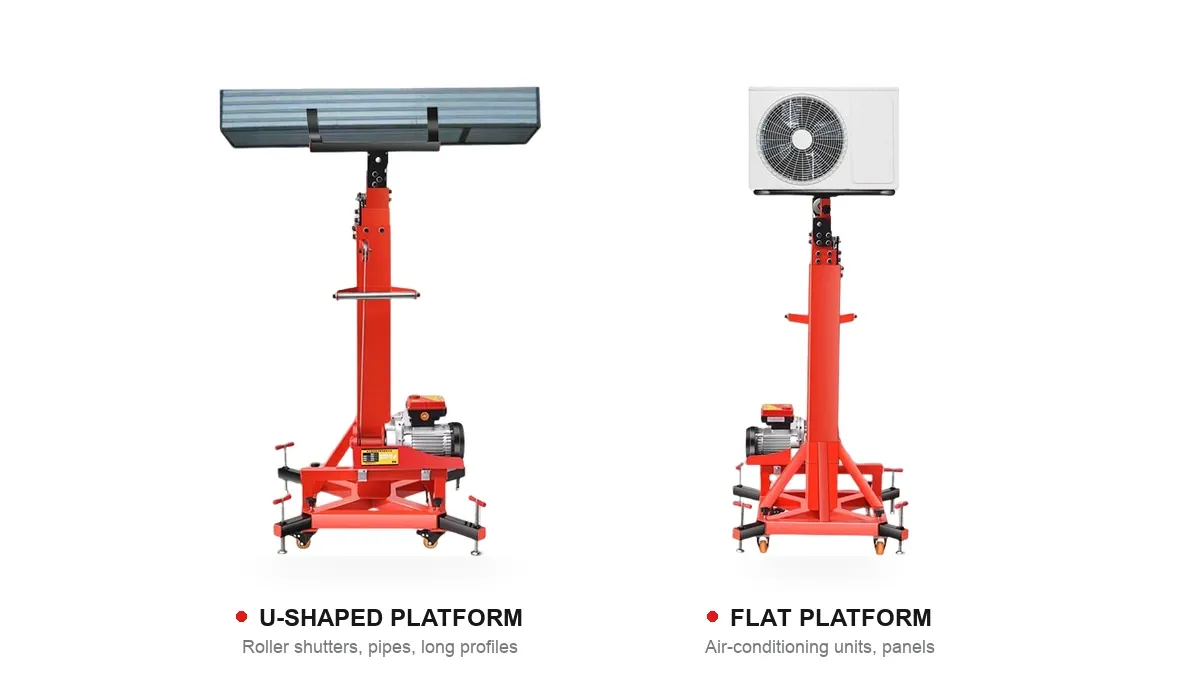
The flat platform: for boxy loads that need a surface
A flat support platform is a deck. The load sits on it, and gravity does the work of holding it in place.
It suits anything with a flat bottom and a stable centre of gravity: an outdoor air-conditioning condenser, a cold-room panel, a packaged component, a crate, an awning or canopy section. The 60 × 80 cm deck is sized for exactly this class of object.
The flat deck is also the more forgiving option. Because the load rests on a continuous surface, minor imbalance is not a problem, and the operator can slide the object a few centimetres to line it up with its fixing points.
The U-shaped platform: for pipes, axles and profiles
A U-shaped platform is a cradle. The load sits down inside the channel, and the two raised sides stop it moving sideways.
The difference matters most for round and linear loads. A pipe laid on a flat deck can roll; a pipe settled into a U-channel cannot. A roller shutter barrel is long enough that any roll at the top becomes a rack at the bottom, and the channel removes that failure mode entirely.
There is a second, less obvious advantage. With a U-platform, the pipe can be lifted slightly above its bracket and then moved sideways off the platform and into position, rather than lifted clear and lowered in. For a run of pipe being clamped at ceiling height, that changes the whole sequence of the job.
The U-platform is the configuration to specify for pipework, roller shutters, beams and long profiles. Because the geometry has to suit the load, the channel width and the platform design should be confirmed against your actual material before ordering.
Which one to specify
The rule is simple. If the load has a flat bottom and stays put when you set it down, use the flat platform. If the load is round, long, or likely to roll or slide, use the U-platform.
If you install both kinds of work — condensers in summer and shutters or pipework the rest of the year — the practical answer is one mast and two platforms, swapped between jobs.
What the lift replaces, and what it does not
Against a ladder and a rope
The traditional method for raising a condenser or a shutter barrel is two people, one ladder, and a rope. It works, and it costs nothing to hire. It also requires two people, takes as long as the climb takes, and has no way to hold the load still while somebody fixes it.
A lift converts a two-person job into a one-person job with a second person guiding at the top — and the load stays where it was put.
Against scaffolding
Scaffolding is the right answer when people need to work at height for hours. It is the wrong answer for a 20-minute installation, because erection and dismantling take longer than the job.
Against a scissor lift or a boom lift
Powered access platforms are designed to carry a person. They are heavier, need trained operators in most jurisdictions, require ground conditions that support their point loads, and cost considerably more to hire.
A material lift is the opposite trade: it carries the load instead of the person, which makes it smaller, cheaper, and usable in places a powered platform cannot reach — a narrow side passage, a finished driveway, an upper floor with a lift-shaft doorway.
The honest limits
A lift sold honestly comes with its limits stated plainly.
It is for materials only. It is not for lifting people. This is not a disclaimer buried in a manual; it is the design premise. The platform has no guardrails because it is not a working platform for a person.
Rated capacity of 220 kg is a limit, not a target. Loads must stay within the stated capacity and be loaded according to the operating instructions for the configuration supplied.
The machine needs reasonably firm, level ground under its base. It is not designed for soft excavation, steep slopes or loose fill.
Large flat panels — an oversized cold-room panel, a big awning — present wind area. A panel that is well within the weight limit can still be a handling problem in a strong crosswind, and the job should be planned accordingly.
Choosing a height: 3.7 m, 4.2 m, 4.5 m or 4.9 m
Our range includes 3.7 m, 4.2 m, 4.5 m and 4.9 m versions of the same concept. The instinct is to buy the tallest. That is usually the wrong instinct.
More lifting height means more mast, and more mast means more weight to wheel around and a larger footprint when it is not in use. If your work sits at 3 m, a 4.9 m lift spends its life carrying mass you never use.
The number to size against is the height of the fixing point, plus the height of the object being fixed, plus a working margin for the platform itself. Measure the actual installation, not the building.
Frequently asked questions
Can one person install an AC condenser with a mini vertical lift?
Yes, with a qualification. One person operates the lift and positions the unit; a second person at the top is still safer for guiding and bolting, particularly on a wall bracket where the unit has to be aligned onto studs. The lift removes the need to hold the weight, not the need for care.
Will the U-shaped platform fit my pipe diameter?
The channel has to suit the load, and pipe diameters vary widely between trades. Confirm the platform geometry against your actual material when ordering rather than assuming a standard size will accept it.
Does it work indoors?
Yes, where there is a 220 V supply, adequate floor, and headroom for the mast. Indoor work — cold rooms, plant rooms, service risers — is one of its stronger applications, because a powered access platform often will not fit through the door.
What happens if the power fails mid-lift?
That is a question to put to the manufacturer for the specific configuration supplied, and the answer should be in the operating instructions. Ask before you buy; it is a fair question and a supplier who has thought about it will answer directly.
Is a mini vertical lift the same as a scissor lift?
No. A scissor lift raises a person and their tools on a guarded platform. A mini vertical lift raises material on an unguarded platform and is not designed to carry anyone. They solve adjacent problems and are not interchangeable.
Matching the machine to the job
The useful way to choose is to start from the installation and work backwards. What is the fixing height? What does the object weigh, and what shape is its underside? Does it need a deck or a cradle? Can one person reach the fixing point from the ground, or is a second person needed at the top?
Answer those four questions and the specification follows: a height, a capacity, and one of two platform types.
The vertical lift and freight elevator range covers the 3.7 m to 4.9 m models, including the 4.9 m portable electric material lift shown with the flat platform configuration. If your work is more about getting panels onto a roof than about interior installation, the guide to lifting solar panels to a roof covers that case with a different class of machine.
To specify a lift against a specific job, send us the working height, the load weight and dimensions, and your power supply and we will confirm the model and platform configuration that fits.